A black Peterbilt tractor pulling out under lights, filmed from the side.

Freight dispatch & commercial insurance

Trucking is a business, not just a truck

Dispatch that plans your revenue per day instead of chasing rate per mile — and a licensed insurance broker who reads the policy before you sign it. Both from one person.

Dispatch rate
10%
Box trucks and semis alike
Invoicing
Friday
Weekly, every week
Notice to leave
30 days
No long-term contract
What I do

Two jobs that most carriers pay two people to get wrong

01

Freight dispatch

I plan loads around revenue per day, reload opportunity and what the run actually costs you — not the number on the rate confirmation. Route planning, rate negotiation, broker relations, load vetting, back office.

  • Flat 10% per load, box trucks and semis alike
  • Invoiced every Friday
  • 30-day notice, no long contract
How dispatch works
02

Commercial trucking insurance

I am a licensed property and casualty broker, which means I shop multiple carriers instead of quoting one. Auto liability, cargo, physical damage, trailer interchange, non-trucking liability, cyber.

  • Independent broker, not a captive agent
  • Policy review before you renew
  • Filings handled for a new authority
See coverage
Why one person can do both

A dispatcher works for you. A broker works between you.

A freight broker is a licensed intermediary: they hold the contract with the shipper and the money moves through them. A dispatcher works under your authority, as your agent, and never contracts with a shipper directly. That line is the whole legal difference — and it is why your dispatcher having eyes on your insurance is an advantage rather than a conflict.

The full difference
Where a dispatcher sits versus where a freight broker sits A diagram of a freight transaction. The shipper is at the top left, a licensed freight broker at the top right, and the carrier at the bottom. Money flows from the shipper through the broker to the carrier along a solid line. The dispatcher is drawn inside the carrier's boundary, working under the carrier's own operating authority, connected to the carrier rather than to the shipper. A dashed line marks the boundary a dispatcher must not cross, which is contracting directly with a shipper. SHIPPER HAS THE FREIGHT FREIGHT BROKER LICENSED · BONDED YOUR AUTHORITY CARRIER THE TRUCK DISPATCHER YOUR AGENT CONTRACT + MONEY RATE CONFIRMATION NOT THIS NO DIRECT DEAL DISPATCH FEE IS PAID BY YOU, OUT OF WHAT YOU WERE PAID
A dispatcher works for the carrier, not between the parties FIG-06

A line of tractors parked in a yard at dusk.

Hampton Roads, Virginia

Dispatching, fleet management, and insurance aren’t separate. They work together.

— Shay Denise

Owner-operators since 2022
Equipment dispatched Box truck + Semi truck
The actual problem

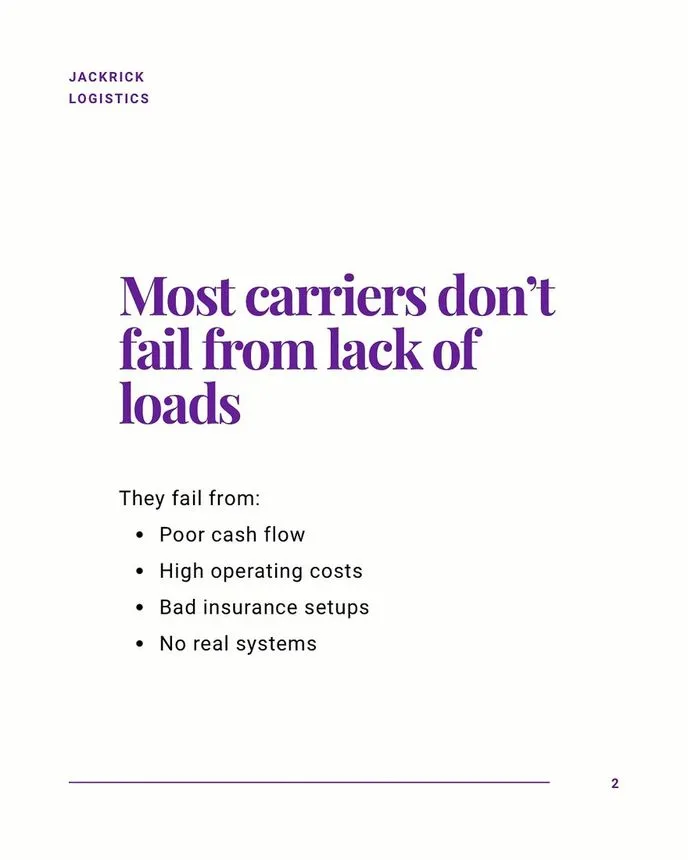
Most carriers don’t fail from lack of loads

They fail from:

01 Poor cash flow
02 High operating costs
03 Bad insurance setups
04 No real systems

Three of those four are things a dispatcher and a broker touch every single week. That is why I do both.

From her own deck
Slide reading "Most carriers don't fail from lack of loads. They fail from: poor cash flow, high operating costs, bad insurance setups, no real systems."
Three of those four are things a dispatcher and a broker touch every week.
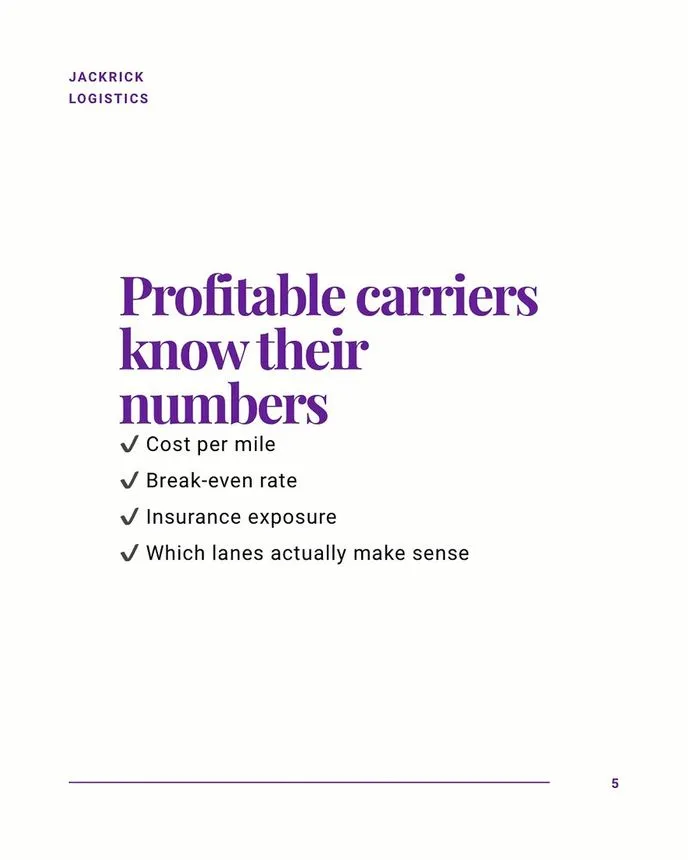
Slide reading "Profitable carriers know their numbers", listing cost per mile, break-even rate, insurance exposure, and which lanes actually make sense.
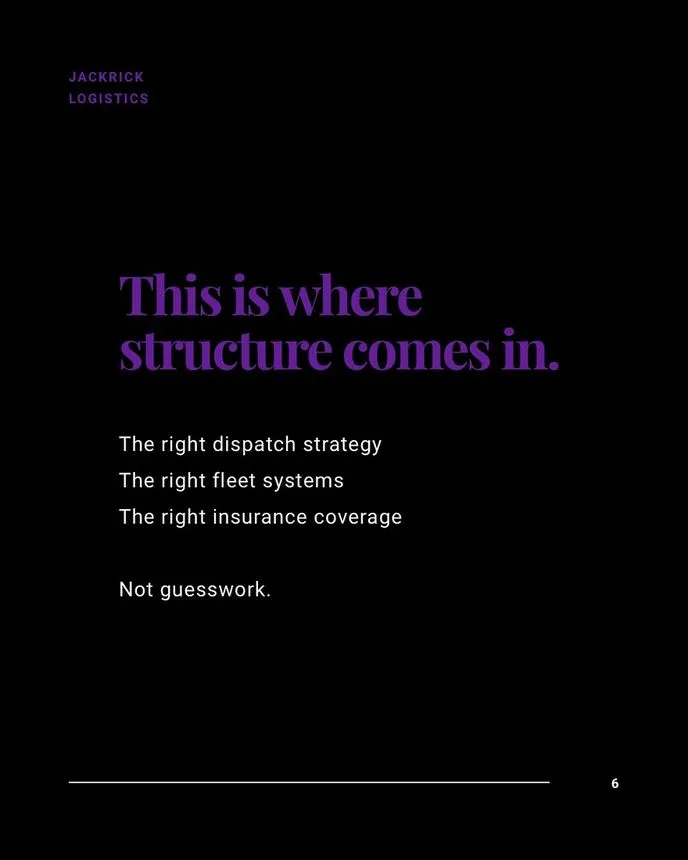
Dark slide reading "This is where structure comes in — the right dispatch strategy, the right fleet systems, the right insurance coverage. Not guesswork."
Know your numbers

Rate per mile is not profit per mile

The number on the load board is revenue. What is left after fuel, tires, maintenance, the note, the insurance and the miles you ran empty is the only number that decides whether you are still trucking next year.

Work out your own and the rest of this site gets more useful — you will know which loads to turn down before you call about them.

How one mile of revenue is consumed by cost A horizontal stacked bar showing a single mile of running cost split into fuel, maintenance, insurance, truck note and other fixed costs. The end of the bar is marked as the break-even point. A separate line above shows a booked rate, and the gap between break-even and rate is labeled as the only part that is profit. No dollar figures are shown, because the figures differ for every operation. THE RATE YOU BOOKED PROFIT FUEL MAINT TIRES INS NOTE BREAK-EVEN VARIABLE — MOVES WITH THE MILE FIXED — YOU PAY IT PARKED RATE PER MILE IS NOT PROFIT PER MILE
One mile, by where the money goes FIG-03
  1. 01 Cost per mile
  2. 02 Break-even rate
  3. 03 Weekly fixed expenses
  4. 04 Tax reserve percentage
  5. 05 True net profit
Three mistakes that kill the math
Three mistakes that break owner-operator cost arithmetic Three numbered cards. One: mixing time frames — adding weekly miles but comparing them against monthly expenses; the fix is to always match the time frames. Two: forgetting fixed costs — counting fuel, tolls and repairs but skipping insurance, permits, truck payments and dispatcher or broker fees; the fix is to track both fixed and variable costs. Three: not separating business and personal — mixing personal spending with trucking costs; the fix is a separate account and card for the business. 1 MIXING TIME FRAMES Weekly miles set against monthly bills. QUICK FIX MATCH THE PERIODS 2 FORGETTING FIXED COSTS Fuel and repairs counted. Insurance, permits and the note skipped. QUICK FIX FIXED + VARIABLE 3 BUSINESS MIXED WITH PERSONAL Grocery runs and truck costs in the same account. QUICK FIX SPLIT THE ACCOUNTS ALL THREE PRODUCE A COST PER MILE THAT LOOKS FINE AND ISN’T
Where owner-operator arithmetic goes wrong FIG-13

Her breakdown of where owner-operator arithmetic goes wrong, from her feed.

Getting started

Four steps, about fifteen minutes

  1. 01 Submit the carrier intake form
  2. 02 Credentials verified
  3. 03 Contact to finalize the Dispatch Carrier Agreement
  4. 04 First loads booked, and your Friday invoice arrives like clockwork
The order in which a new trucking authority comes together Five sequenced milestones along a runway: forming the business entity, registering for a USDOT number, applying for MC operating authority, placing insurance and having the filings made, and finally becoming active. Behind them, a rising curve shows broker acceptance improving as the authority ages, with markers where common thirty, sixty and ninety day requirements sit. Two milestones are marked as waiting periods rather than tasks. BROKERS WHO WILL LOAD YOU ENTITY LLC + EIN USDOT REGISTER MC AUTHORITY INSURANCE FILINGS ACTIVE RUN FREIGHT WAIT 30 DAY 60 DAY 90 DAY DAY ONE START WITH BROKERS WHO TAKE NEW AUTHORITIES
Sequence, not a checklist — some of it is waiting FIG-10

What to have ready

  • MC number
  • USDOT number
  • EIN
  • W-9
  • Certificate of Insurance (COI)
  • MC Authority Letter
  • Truck and trailer details
  • Factoring company information (if applicable)

The intake form takes 10–15 minutes.

Pricing

The rate, in public

Most dispatch services will not tell you what they charge until they have your phone number. Here is mine.

Dispatch rate 10% per load — box trucks and semis alike
Retainer None You are billed on what got booked
Invoiced Weekly Every Friday
Termination 30 days Written notice, no penalty
A working week with Friday marked as the invoicing day Seven day columns from Monday to Sunday. Loads run through the week as a continuous line. Friday is marked as the invoicing day, when the dispatch invoice is issued for the week's work. Saturday and Sunday are shown lighter. MON TUE WED THU FRI SAT SUN INVOICE ISSUED SAME DAY EVERY WEEK — NO SURPRISE BILLING
Invoiced every Friday, every week FIG-07

No retainer, no minimum, no lock-in

You are billed on what got booked, on the same day every week. If it stops working for you, 30 days’ written notice ends it — there is no penalty clause to argue about, because there is no long-term contract to leave.

How the pricing models compare
The insurance side

Somebody has to read the policy

A captive agent has one carrier to sell you. As an independent broker I shop several — and then read the exclusions on the one you are about to sign, which is where the coverage you thought you bought usually goes missing.

Auto liability, motor truck cargo, physical damage, trailer interchange, non-trucking liability, occupational accident, cyber.

See what each one covers
Three insurance quotes fanned out, with the exclusions being read Three policy quote documents fanned across a desk. The front document is open and a magnifier sits over its exclusions section rather than over the premium. Two further quotes sit behind it, indicating that an independent broker shops several carriers rather than quoting one. PREMIUM LIMITS EXCLUSIONS SIGNATURE READ THIS FIRST NOT THE PREMIUM
Shopping several carriers, then reading the one you sign FIG-04
Shay Denise, freight strategist and commercial insurance broker at JackRick Logistics
Who you'd be working with

Shay Denise

Freight Strategist & Commercial Insurance Broker

Based in Hampton Roads, Virginia, working with owner-operators and small fleets since 2022. Sociology and criminal justice degree from Old Dominion — which sounds unrelated until you watch her pull apart a rate confirmation.

A $4.00/mile load isn't always better than a $2.20/mile load.

— Shay Denise, Jun 19, 2026

More about Shay

FAQ

Questions people actually ask

What does dispatch cost?

A flat 10% per load — the same rate for box trucks and semis. Invoiced every Friday. You can leave on 30 days' written notice, with no long-term contract.

I can book my own loads. Why would I pay someone 10%?

Booking freight is not the hard part. Running compliant, keeping brokers happy, making sure your insurance does not get you turned away at the gate, and protecting profit after fuel, factoring and downtime — that is where it gets hard. If you are already clearing your target revenue per day and your paperwork is current, you may not need a dispatcher. That is a real answer, and it is sometimes the right one.

Do you work with brand new authorities?

Yes, and it is a lot of the work. New authorities need a specific approach: starting with the brokers who accept day-one authorities, then working up to the ones with 30, 60 and 90-day requirements as the authority ages. Going straight at the brokers everyone else wants is how new carriers sit empty.

What do you need from me to get started?

The carrier intake form takes 10–15 minutes. Have your MC number, USDOT number, EIN, W-9, Certificate of Insurance (COI), MC Authority Letter and truck details to hand. Credentials get verified, then we finalize the dispatch agreement.

You do insurance as well? Is that a conflict?

It is the opposite. Your dispatcher is the person who finds out first when a broker rejects your certificate, when a load needs trailer interchange you do not carry, or when your limits are about to cost you a lane. As an independent broker I shop multiple carriers rather than quoting one. You are free to use your own agent and plenty of clients do.

What equipment do you dispatch?

box truck and semi truck freight. Dry van, reefer, power-only and intermodal lanes.

Tell me what you're running

Call or text (757) 744-2484, or send the intake form and I'll come back to you with something specific about your operation — not a brochure.

Call or text Get started