How much is truck insurance for an owner-operator?
There is no single number, and any page that gives you one is inventing it. Commercial trucking insurance is individually underwritten — two owner-operators with the same truck can pay very differently.
What decides your premium, in order: authority status, driving record, radius, commodity, equipment value and how long you have been operating. This page explains each one so you can tell whether the quote in front of you is reasonable.

A national average premium describes no actual carrier. Publishing one would make this page look more useful and make your decision worse. What follows is the underwriting logic instead — which is the thing that actually lets you evaluate a quote.
First: which product are you even buying?
This is the fork in the road, and getting it wrong costs more than every other factor combined.
- Running under your own authority. You need primary auto liability (filed with FMCSA), cargo, and usually physical damage. Primary liability is the expensive line.
- Leased on to a motor carrier. They provide primary liability while you are under dispatch. You need non-trucking liability and physical damage — a much smaller bill.
Anyone selling a leased-on driver a full primary liability policy is selling them something they cannot use.
For-hire carriers hauling non-hazardous property in vehicles with a GVWR of 10,001 lb or more must carry at least $750,000 in public liability coverage.
Commonly got wrong: Part 387 was last amended 91 FR 45660, 21 Jul 2026 — the $750,000 figure survived that amendment.
There is no federal cargo-insurance minimum and no federal cargo filing requirement for general freight. The federal cargo rules reach household goods carriers only.
Commonly got wrong: THE most misreported figure in the industry. §387.301T(b) is headed "Household goods motor carriers-cargo insurance" and its prohibition reaches only household goods carriers. §387.303T(c) is headed "Household goods motor carriers: Cargo liability". There is no $100,000 anywhere in Part 387 — that number is a broker and shipper CONTRACT norm, not a regulation. Important caveat to publish alongside it: carrier liability for loss or damage to general freight is a separate body of law (the Carmack Amendment, 49 U.S.C. 14706) and is unaffected. No insurance mandate does not mean no liability.
Note the gap between those two: the federal minimum activates your authority, but brokers commonly require $1,000,000 liability and around $100,000 cargo before they will tender you freight. Buying to the federal number and then finding you cannot get loaded is the most expensive way to save money in this business.
Don't buy insurance just to activate your authority.
The nine factors, in the order they move the number
- 01 Authority status. Own authority versus leased on. Different product, different universe of price.
- 02 Driving record. Violations and accidents in the last three to five years. A single at-fault accident reshapes the quote.
- 03 Years of verifiable CDL experience. Years since licensing is not the same thing, and underwriters know the difference.
- 04 Radius of operation. Priced heavily. Do not claim nationwide because it sounds better — you will pay for miles you never drive.
- 05 Commodity. General freight is the baseline. Hazmat, alcohol, electronics and refrigerated all price differently, and some change the appetite entirely.
- 06 Equipment value and age. Drives the physical damage side and influences liability appetite.
- 07 Time in operation. The biggest reduction available to a new authority is a clean twelve months. Nothing else moves as far, as fast.
- 08 Limits and deductibles. The part you control. Higher deductible, lower premium — within what you could actually fund.
- 09 Garaging location and credit. Where the truck sleeps, not where you incorporated. Many carriers in this class use credit as a rating factor.

Six ways to lower it that are not "shop around"
- Be accurate about radius. Overstating it is the most common self-inflicted cost.
- Raise the physical damage deductible to the largest figure you could genuinely fund tomorrow.
- Pay annually if you can. Installment finance charges are often bigger than a carrier switch would save.
- Keep the MVR clean. It is slow, free, and the most powerful lever there is.
- Shop the first renewal hard. A clean year moves you into a different class and an auto-renewal captures none of it.
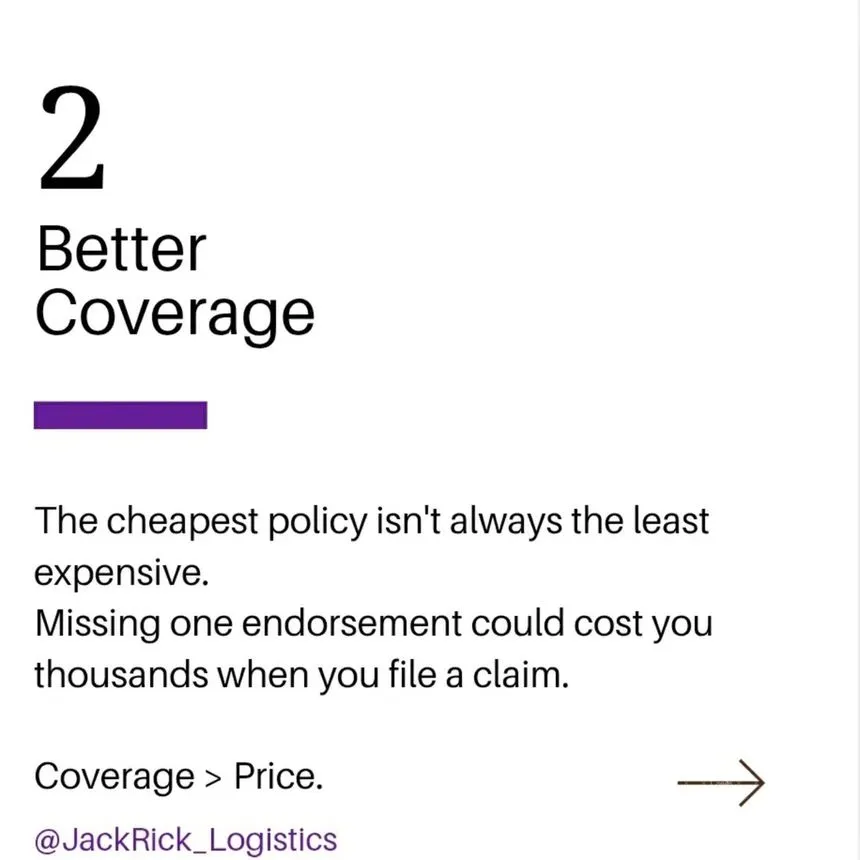
- Report your operation accurately. A policy rated on facts that do not match how you run is a claim denial waiting to happen — the cheapest premium in the world is worth nothing then.
Has anyone actually reviewed my policy, or am I JUST letting it renew?
Get a real number for your operation
Tell me your authority status, your radius, what you haul and what your record looks like. As an independent broker I shop it across multiple carriers rather than quoting you one company's answer.
Insurance is offered through Shay Denise, a licensed property and casualty producer. Coverage is subject to the terms, conditions and exclusions of the policy actually issued. Nothing on this page is a binder, a quote, or an offer of coverage.
Owner-operator insurance cost questions
Why can nobody tell me a price without asking questions?
Because commercial trucking insurance is individually underwritten. Two owner-operators with identical trucks can pay very different premiums based on driving record, radius, commodity, authority age and loss history. Any site that gives you a national average is giving you a number that describes nobody. What a broker can tell you quickly is whether the quote you already have is reasonable for your profile.
What is the single biggest factor?
Whether you are running under your own authority or leased on. Those are two different products at two different price points. Under your own authority you need primary liability, which is the expensive part. Leased on, the motor carrier provides that and you need non-trucking liability plus physical damage — a far smaller bill.
Why is my first year so expensive?
A new authority has no history to price. No loss runs, no CSA score, often limited verifiable experience. Underwriters price the class you belong to rather than the operator you are. That reverses with a clean year, which is why the first renewal is the one worth shopping hardest.
How much can I save by raising my deductible?
Meaningfully on physical damage, much less on liability. Physical damage deductibles are the lever you control most directly. The right level is the largest amount you could pay tomorrow without borrowing — a deductible you cannot fund converts a covered loss into an uncovered one.
Does paying annually save money?
Usually yes, and it is one of the few discounts fully in your control. Monthly installments typically carry finance charges. If you can fund the year up front, ask what the difference is — it is often larger than the savings from switching carriers.
Should I just buy the cheapest quote?
Not without comparing what is in it. The cheapest quote is frequently cheapest because the cargo limit is lower, the deductibles are higher, radius is restricted in a way that does not match how you run, or a coverage you actually need has been left out. Compare the limits and the exclusions, not the premium.