Know your numbers

Break-even rate per mile

The short answer

Your break-even rate is total costs divided by loaded miles — not by all miles. Your costs are spread across every mile you run; your revenue is earned only on the loaded ones.

That is why break-even is always higher than your cost per mile, and the gap between them is exactly your deadhead.

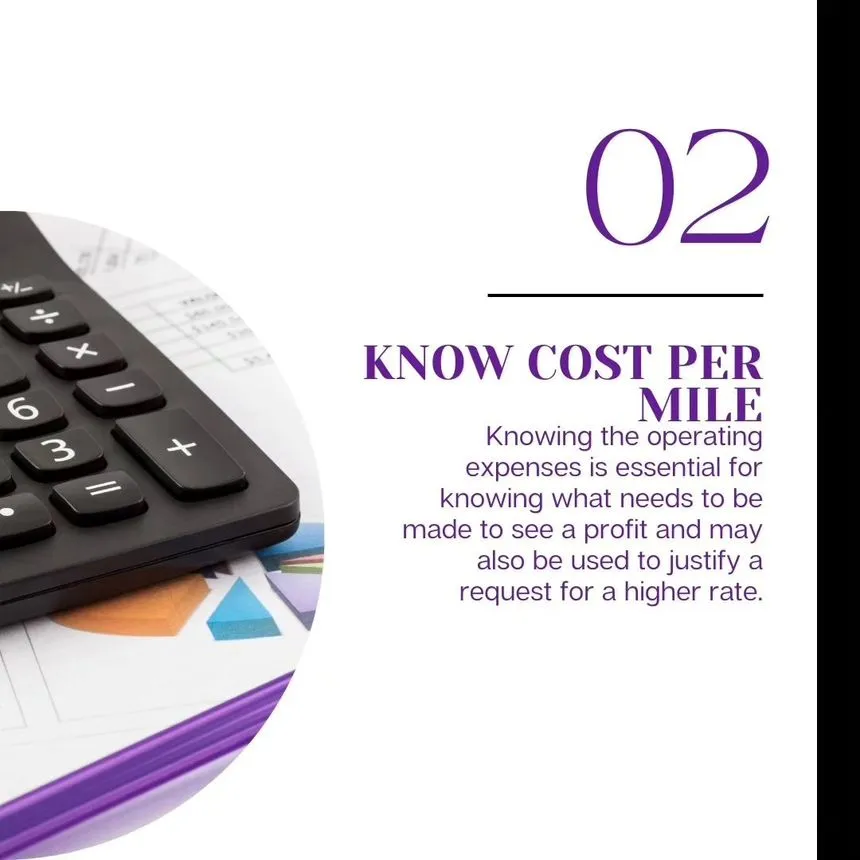
Slide 02, "Know Cost Per Mile": knowing operating expenses is essential for knowing what needs to be made to turn a profit and to justify a request for a higher rate.
Where weekly revenue crosses weekly cost Two lines plotted against miles run in a week. A cost line starts above zero, because fixed costs such as the truck payment and insurance are owed before any mile is driven, and rises gently with fuel and maintenance. A revenue line starts at zero and rises more steeply. The point where they cross is the break-even mile. The area before the crossing is marked as loss and the area after it as profit. No values are shown on either axis, because they differ for every operation. BREAK-EVEN LOSS PROFIT COST REVENUE FIXED COSTS — OWED AT ZERO MILES MILES RUN THIS WEEK →
Fixed costs are owed before the first mile FIG-18
Two loads, worked through
Cover slide headed "Stop Chasing Rate Per Mile — it might be costing you money", tagged Trucking Industry Tips.
Slide headed "Load A": $4.00 per mile, 300 miles, equals $1,200 revenue. "Sounds great… right?"
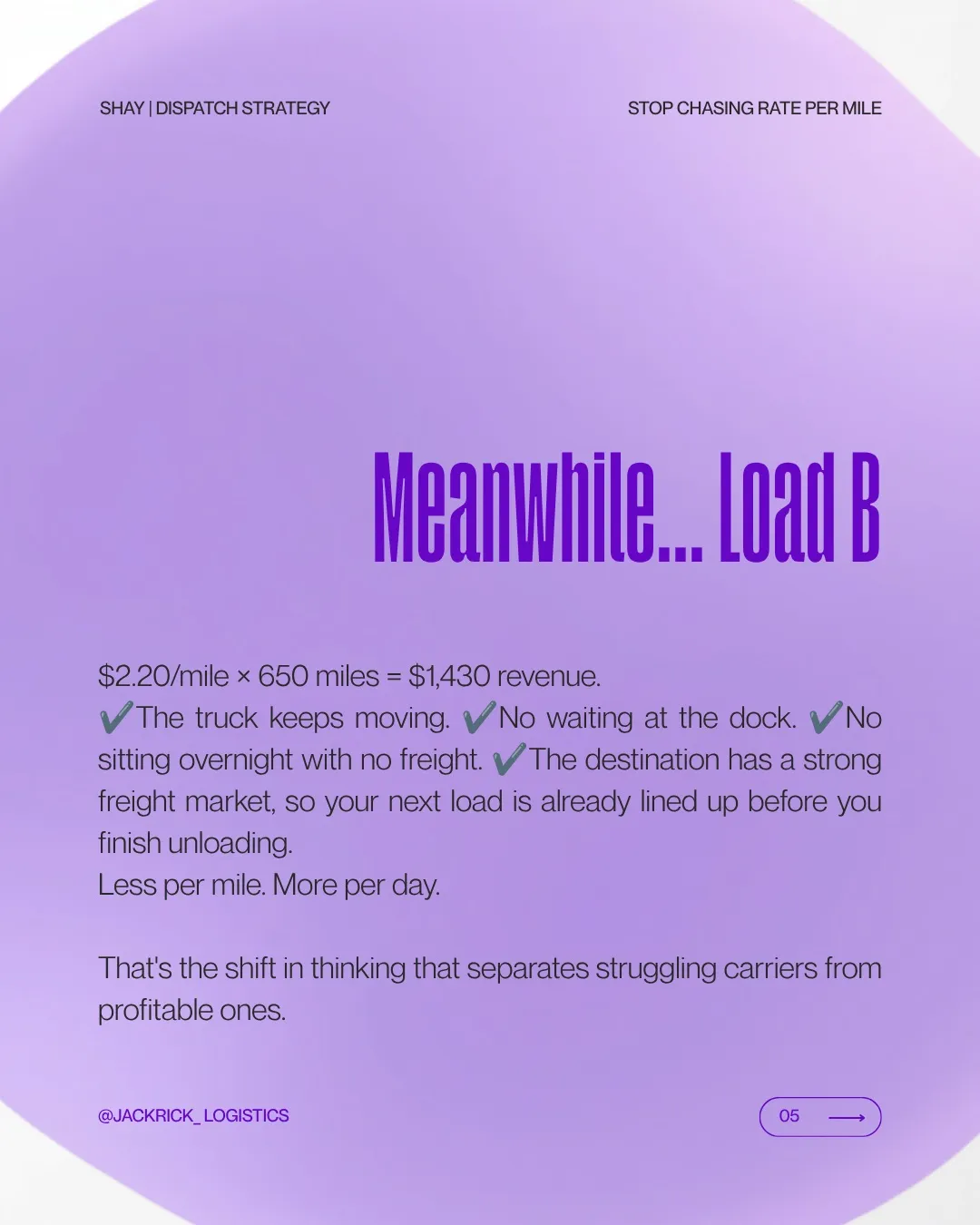
Slide headed "Meanwhile… Load B": $2.20 per mile times 650 miles equals $1,430 revenue. The truck keeps moving, no waiting at the dock, no sitting overnight with no freight, and the destination has a strong freight market so the next load is already lined up before unloading finishes. "Less per mile. More per day." That is the shift in thinking that separates struggling carriers from profitable ones.

Her own numbers, slide by slide.

The difference, in numbers

Two figures people treat as one

A month with 2,000 empty miles
Total costs $18,000 Fixed + variable
Loaded miles 10,000
Empty miles 2,000
Total miles 12,000
Cost per mile $1.50 $18,000 ÷ 12,000 total miles
Break-even rate $1.80 $18,000 ÷ 10,000 loaded miles
The gap $0.30 16.7% deadhead, carried by the loaded miles

Book at $1.60 a mile believing you are $0.10 above cost and you are actually $0.20 below break-even. Do that consistently and you can run hard all year and still lose money — while every load looked profitable on the confirmation.

Calculate yours — free, nothing stored

How to work it out

  1. Pick one period and hold it. A month is the most honest. Mixing timeframes — weekly miles against monthly expenses — is the single most common arithmetic error in trucking, and it makes your number look about a quarter of what it really is.
  2. Add every fixed cost. Truck and trailer payment, insurance, permits and plates, UCR, 2290, ELD, accounting, phone, and your own pay. Anything that happens whether or not the wheels turn.
  3. Add every variable cost. Fuel, DEF, tires, maintenance, tolls, scales, parking, lumpers you were not reimbursed for.
  4. Count loaded miles and empty miles separately. This is the step that makes break-even different from cost per mile, and the step most people skip.
  5. Divide total cost by loaded miles. That is your break-even rate. Below it, the load costs you money to haul.

You add up your miles for a week but compare them against monthly expenses. Quick Fix: Always match time frames (weekly miles vs. weekly expenses OR monthly vs. monthly).


— Shay Denise, Aug 26, 2025
What the number is for
Quick tip slide: "Set an average daily rate. Whether you're a carrier or dispatcher, have an average amount per day that you want your truck or trucks to make, and only secure loads that fall in line with that."
Slide 03, "Know Market Rates": the going rate for a specific lane and commodity can be used as a benchmark for negotiating.
Slide 05, "Know Market Conditions": knowing whether the market favors carriers acts as a temperature check — when demand is high, capacity is leverage in negotiation.

Why deadhead is the fastest lever

Look again at the worked example. Cutting empty miles from 2,000 to 1,000 does not change your loaded miles — so the saving comes from the variable cost of the miles you no longer run. At roughly $0.68 a mile in fuel, tires and wear, that is about $680 off the month, which drops break-even from $1.80 to about $1.73.

Seven cents a mile, for planning the return leg before booking the outbound. Over a year that is roughly $8,200 — and it costs nothing but attention. It is also a dispatch problem rather than a driving problem, which is most of what a dispatcher is being paid to solve.

Dead zones can be profitable, though. Before booking a load, check to see if there are any local runs in that area.

— Shay Denise, Feb 22, 2023

The other two levers are slower. Raising revenue per day means better lanes and better negotiation. Cutting fixed costs usually means refinancing or shopping insurance — real, but not this week.

Where break-even sits among the numbers

It is the second of the five she says every carrier has to know:

  1. 01 Cost per mile
  2. 02 Break-even rate
  3. 03 Weekly fixed expenses
  4. 04 Tax reserve percentage
  5. 05 True net profit
Her working method
Three mistakes that break owner-operator cost arithmetic Three numbered cards. One: mixing time frames — adding weekly miles but comparing them against monthly expenses; the fix is to always match the time frames. Two: forgetting fixed costs — counting fuel, tolls and repairs but skipping insurance, permits, truck payments and dispatcher or broker fees; the fix is to track both fixed and variable costs. Three: not separating business and personal — mixing personal spending with trucking costs; the fix is a separate account and card for the business. 1 MIXING TIME FRAMES Weekly miles set against monthly bills. QUICK FIX MATCH THE PERIODS 2 FORGETTING FIXED COSTS Fuel and repairs counted. Insurance, permits and the note skipped. QUICK FIX FIXED + VARIABLE 3 BUSINESS MIXED WITH PERSONAL Grocery runs and truck costs in the same account. QUICK FIX SPLIT THE ACCOUNTS ALL THREE PRODUCE A COST PER MILE THAT LOOKS FINE AND ISN’T
Where owner-operator arithmetic goes wrong FIG-13

Have someone apply it to your week

Knowing the number is step one. Booking against it every day, including the return leg, is the job.
And the conclusion
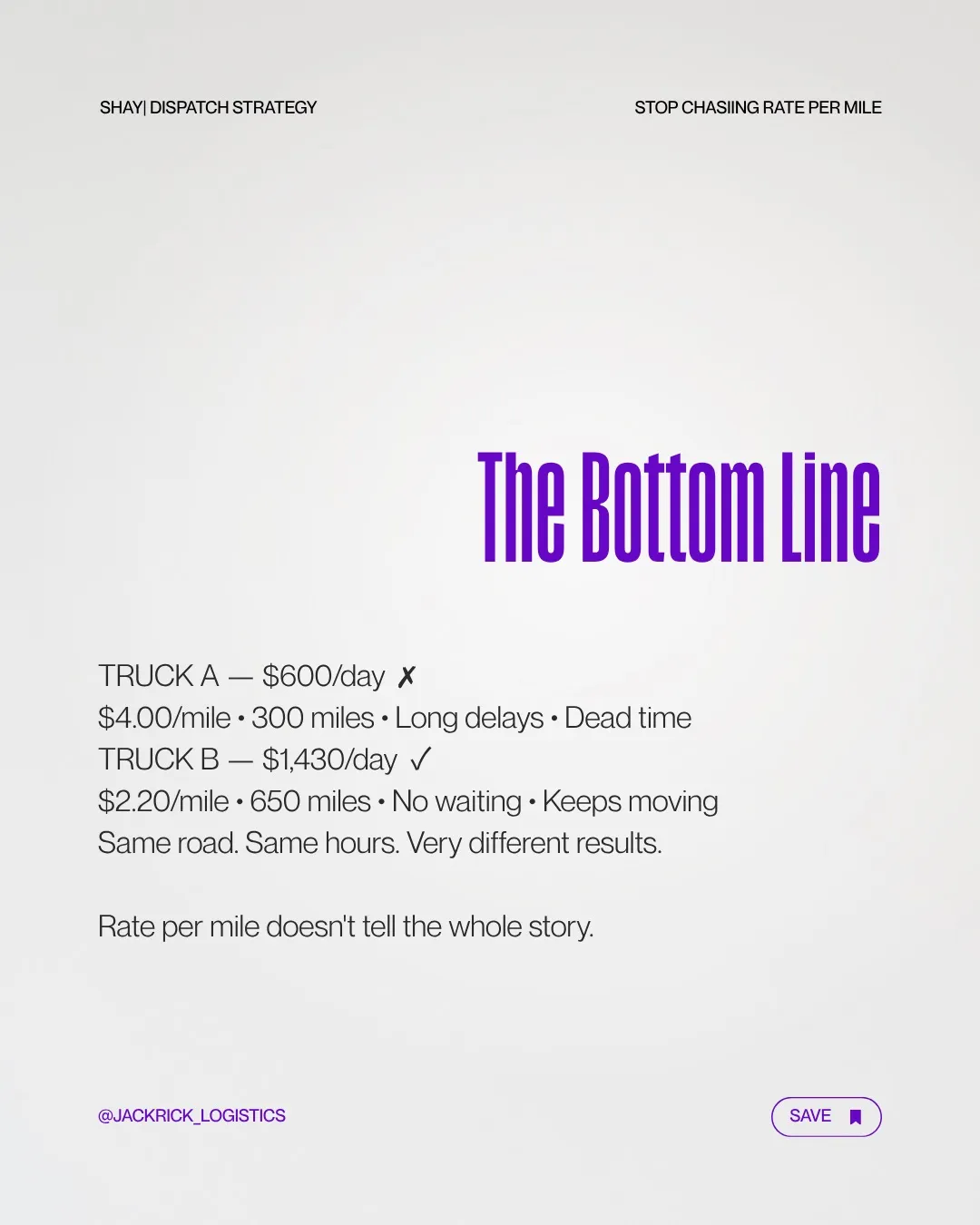
Slide headed "The Bottom Line": Truck A earns $600 a day at $4.00 per mile over 300 miles with long delays and dead time; Truck B earns $1,430 a day at $2.20 per mile over 650 miles with no waiting and constant movement. Same road, same hours, very different results. "Rate per mile doesn't tell the whole story."
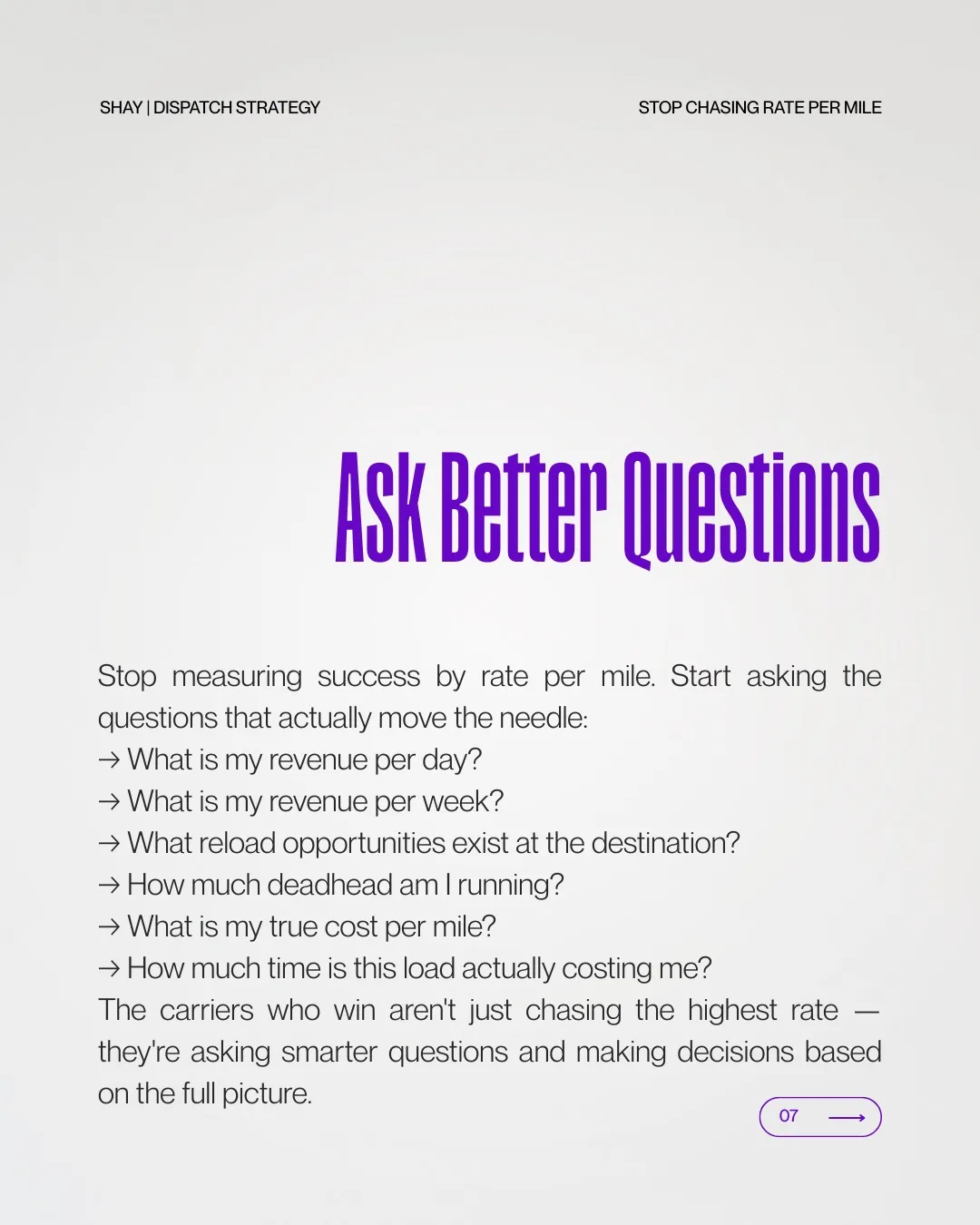
Slide headed "Ask Better Questions": stop measuring success by rate per mile and start asking what is my revenue per day, what is my revenue per week, what reload opportunities exist at the destination, how much deadhead am I running, what is my true cost per mile, and how much time is this load actually costing me. The carriers who win are not just chasing the highest rate — they are asking smarter questions and making decisions based on the full picture.
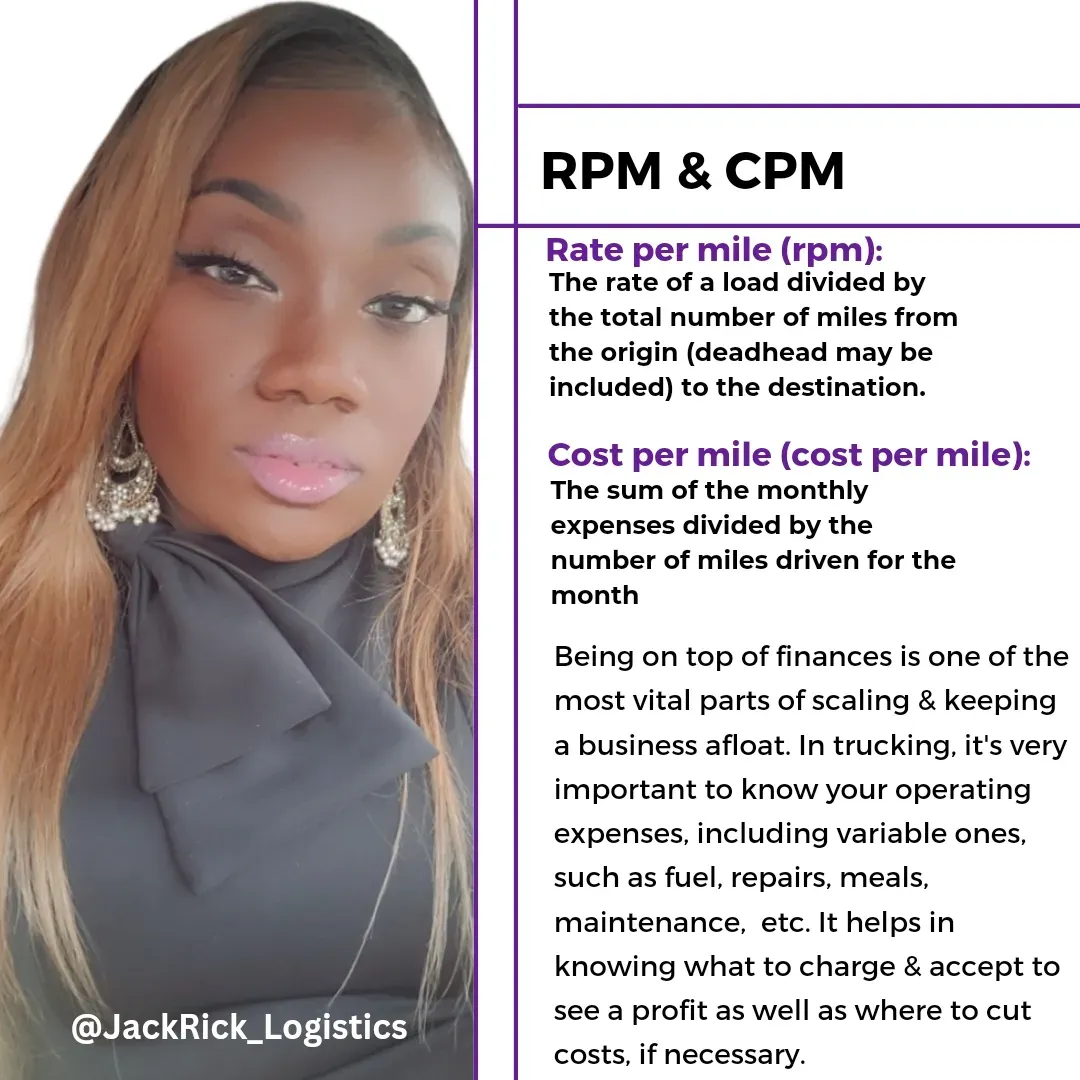
Definition slide headed "RPM & CPM". Rate per mile: the rate of a load divided by the total number of miles from the origin, deadhead possibly included, to the destination. Cost per mile: the sum of the monthly expenses divided by the number of miles driven for the month. Knowing operating expenses, including variable ones such as fuel, repairs, meals and maintenance, helps in knowing what to charge and accept to see a profit, and where to cut costs if necessary.
How one mile of revenue is consumed by cost A horizontal stacked bar showing a single mile of running cost split into fuel, maintenance, insurance, truck note and other fixed costs. The end of the bar is marked as the break-even point. A separate line above shows a booked rate, and the gap between break-even and rate is labeled as the only part that is profit. No dollar figures are shown, because the figures differ for every operation. THE RATE YOU BOOKED PROFIT FUEL MAINT TIRES INS NOTE BREAK-EVEN VARIABLE — MOVES WITH THE MILE FIXED — YOU PAY IT PARKED RATE PER MILE IS NOT PROFIT PER MILE
One mile, by where the money goes FIG-03
FAQ

Break-even questions

What is my break-even rate per mile?

The rate your loaded miles must earn to cover every cost of running the truck, including the empty miles that earned nothing. It is higher than your cost per mile, and the gap is your deadhead percentage.

How is it different from cost per mile?

Cost per mile is total costs divided by total miles — loaded and empty. Break-even rate is total costs divided by loaded miles only, because loaded miles are the only ones that generate revenue. If a quarter of your miles are empty, your break-even rate is about a third above your cost per mile.

Should I include my own pay?

Yes, as a fixed cost, at the amount you actually need to live on. A break-even calculated without paying yourself tells you the rate at which the truck survives, not the rate at which you do. Those are very different numbers and only one of them is a business.

Is it ever right to take a load below break-even?

Occasionally, and deliberately. Repositioning out of a dead zone, getting home, or holding a lane with a customer you want long-term. The distinction is whether you know it is below break-even when you accept it. Doing it knowingly is strategy; doing it unknowingly is how carriers fail while staying busy.

How often should I recalculate?

Quarterly at minimum, and immediately after any change to fuel, insurance, your truck payment or your maintenance pattern. A break-even figure from last year is a guess wearing a number.

My break-even looks too high. What now?

That is usually the correct answer rather than a mistake, and it is the point of the exercise. The three levers are: cut deadhead, raise revenue per day, or cut fixed costs. Deadhead is normally the fastest and it is a dispatch problem, not a driving problem.

Call or text Get started