Owner-operator profit per mile
Profit per mile is what is left after everything — including your own pay, your tax reserve and your maintenance reserve — divided by the miles you ran.
Most carriers who think they are measuring profit are measuring revenue minus fuel. That gap is why a busy year can end with nothing in the account.



From gross to what you keep
Every line below comes out of the top number before anything is yours. The order is roughly the order people forget them in.
- 01Gross revenueThe number people quote at truck stops
- 02− Dispatch or brokerage feeA percentage of the load, or a flat weekly fee
- 03− Factoring feeSmall per invoice, meaningful per year
- 04− Fuel and DEFUsually the largest single variable cost
- 05− Tolls, scales, parking, lumpersSmall individually, constant in aggregate
- 06− Truck and trailer paymentFixed — it arrives whether you run or not
- 07− InsuranceLiability, cargo, physical damage, occ-acc
- 08− Permits, plates, UCR, 2290, IFTA, ELDAnnual and quarterly, easy to forget monthly
- 09− Maintenance and tire reserveReserved per mile, not paid when it breaks
- 10− Your own payA cost, not the leftovers
- 11− Tax reserveMoved out the week you are paid
- =True net profitDivided by miles: your profit per mile
Most carriers don't fail from lack of loads
Where a strong-looking month actually lands
Using the same figures as the cost-per-mile worked example — 10,000 loaded miles, 2,000 empty, $18,000 of total cost including a $5,000 owner's pay.
Twenty-five cents a mile of genuine profit, on top of paying yourself $5,000. That is a healthy month. Take the owner's pay out of the cost column and "profit" becomes $8,000 — a number that looks better and tells you nothing.



The three reserves that separate a business from a hustle
- Tax. Moved to a separate account the week the money arrives. The percentage is between you and your accountant; the timing is not negotiable.
- Maintenance. Reserved per mile as though it were a bill. Breakdowns are scheduled events with unknown dates.
- Slow season. Freight is cyclical. The carriers who survive a soft market are the ones who funded it during a good one.
A carrier without these reserves is not choosing to take cheap freight when the turbo goes — they are forced to, which is a much worse position and it compounds.
Where profit per mile sits among the numbers
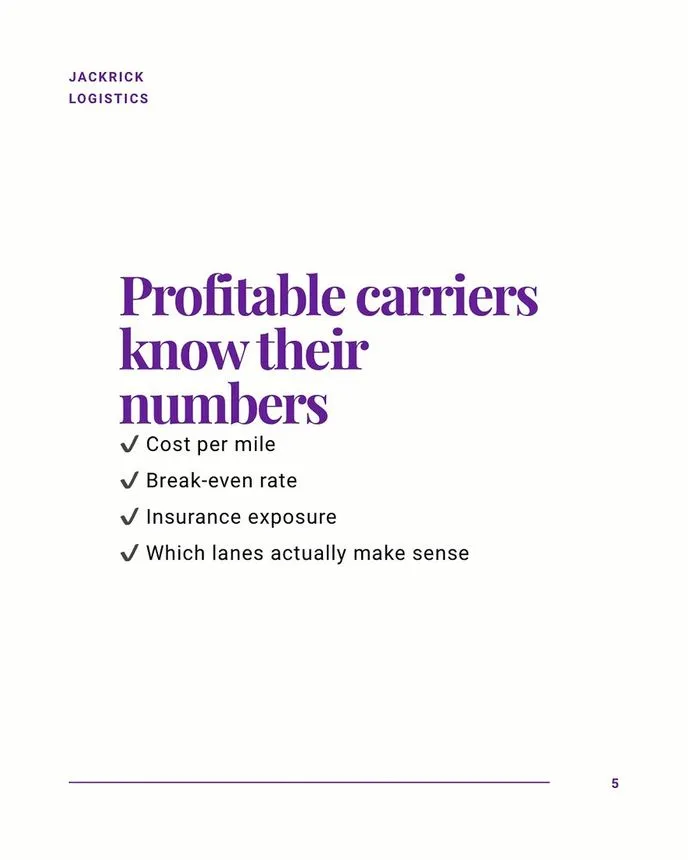
It is the last of the five, and it depends on all four before it:
- 01 Cost per mile
- 02 Break-even rate
- 03 Weekly fixed expenses
- 04 Tax reserve percentage
- 05 True net profit
I don’t believe in telling business owners, “You need this policy,” without explaining WHY. I want you to understand the risk first. Then, we can talk about the solution.
Know the number, then protect it
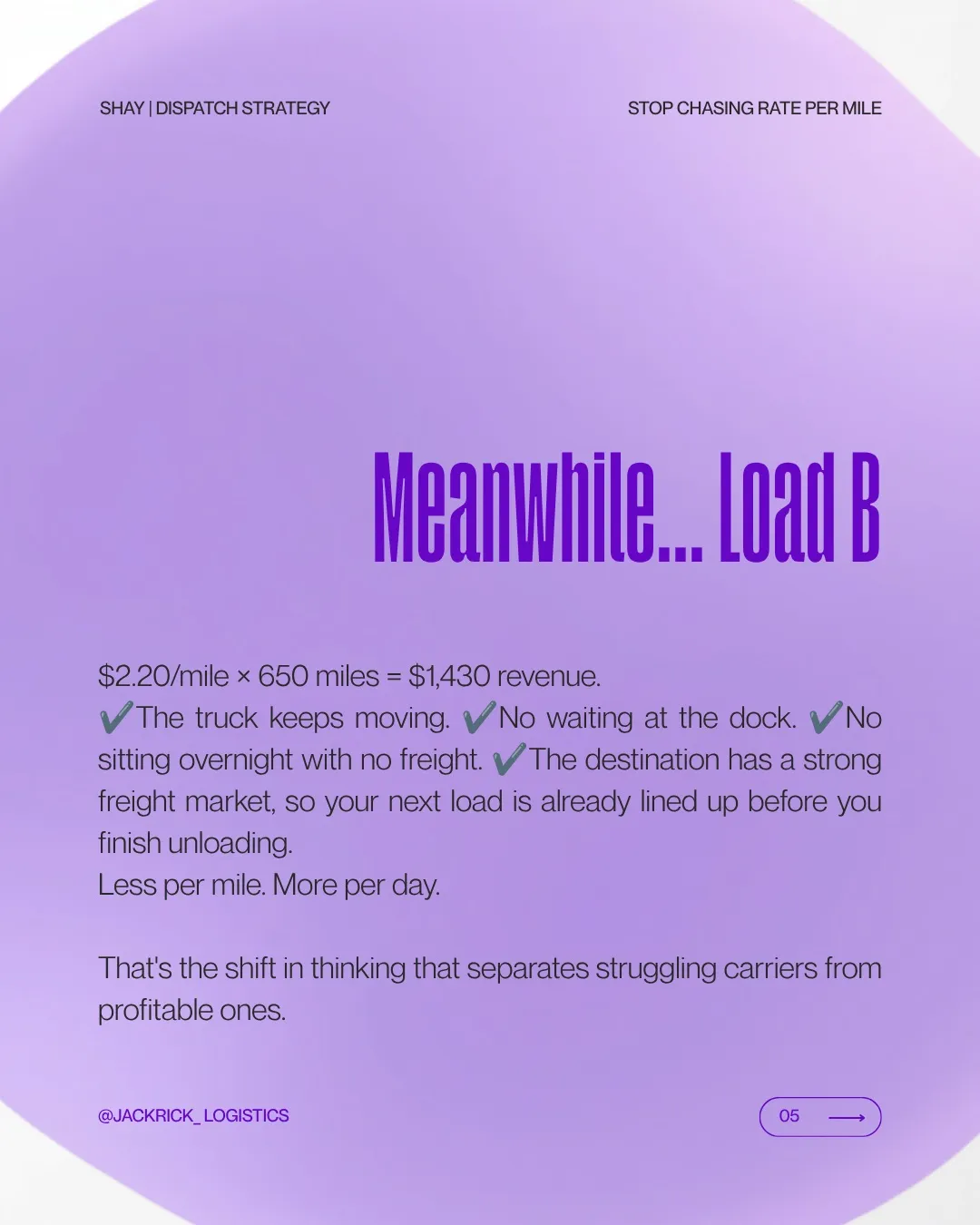
Dispatch that books against your break-even instead of against the board is how the profit line stays positive in a soft market.


Profit per mile questions
What is profit per mile?
What is left after every cost of running the business, divided by the miles you ran. Not revenue per mile, and not revenue minus fuel. If your tax reserve, your maintenance reserve and your own pay are not in the calculation, the number you are looking at is not profit.
Why does my gross look great and my bank account not?
Because gross is the first number in a long subtraction. Fuel, the truck payment, insurance, maintenance, tires, permits, factoring fees, dispatch, tolls, parking, accounting and tax all come out before anything reaches you. A carrier grossing well can be losing money and stay busy the whole time — busy is not the same as profitable.
Should I count my own pay as a cost or as profit?
As a cost. Pay yourself a defined amount as a fixed expense, then measure profit on top of that. If your pay is whatever happens to be left, you have no way of telling a good month from a bad one, and no way of knowing whether the business would survive hiring a driver to replace you.
How much should I reserve for tax?
Set a percentage and move it out of the operating account the week you get paid, not at quarter end. The exact percentage depends on your entity and your situation and is a question for your accountant — but the discipline of separating it immediately is what prevents the January problem, whatever the number is.
What about maintenance?
Reserve for it per mile, every settlement, as though it were a bill. Major repairs are not surprises, they are scheduled events with unknown dates. A carrier without a maintenance reserve is one turbo away from taking bad freight to cover a repair, which is how a mechanical problem becomes a business problem.
Is profit per mile the right metric?
It is the right accounting metric and the wrong booking metric. Use profit per mile to judge the business over a month. Use revenue per day to judge an individual load, because a load consumes days rather than miles.